ECG Cases
ECG interpretation practice on real 12-lead EKGs. Quiz cases, answers explained.
Get it on Google Play
For study only. This does not replace advice or diagnosis from a healthcare professional.
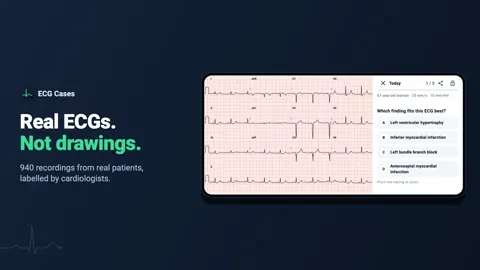
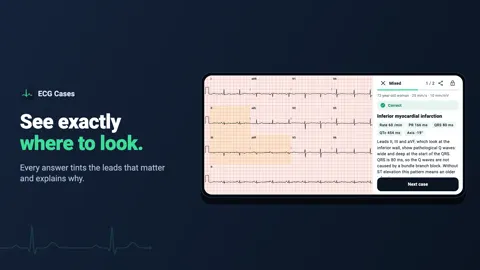
ECG Cases is an app for learning to recognise findings on 12-lead ECGs. Each question shows a real recording, you pick the finding, and the app shows which leads point to the answer and why. It is made for medical students, nursing students, nurses, paramedics and junior doctors who want repeated practice for exams or ward teaching.
Why real recordings matter for practice
Textbook ECG drawings are clean. Real tracings are not. Baseline wander, uneven complexes and borderline measurements are part of what you have to learn to look past. ECG Cases uses 940 recordings from real patients, each labelled by cardiologists. A recording only goes into the app when the cardiologist’s label and an independent computer analysis agree, and its measurements meet the criteria for that finding.
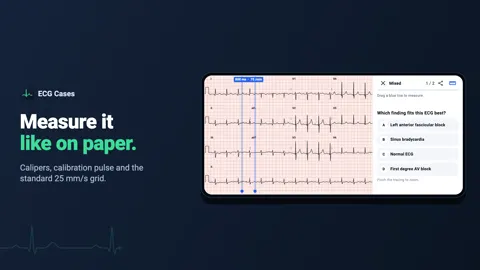
Tracings are printed the standard way: twelve leads, a long lead II rhythm strip, 25 mm/s, 10 mm/mV and a 1 mV calibration pulse. Pinch to zoom into any complex.
What a good practice session looks like
You see the full ECG and choose from a short list of answers. The options are picked from the findings most often confused with the right one, so a guess is not enough. After you answer:
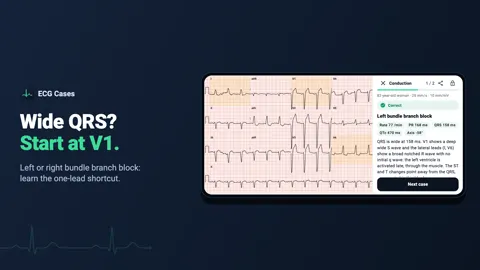
- The leads that matter are tinted on the tracing, and the tracing stays on screen while you read.
- You see the heart rate, PR interval, QRS duration, QTc and axis of that very recording.
- The criteria for the finding are written in plain words.
- If you were wrong, you see what you chose next to what it really was.
That last step is where most of the learning happens. Comparing a wrong pick with the correct finding on the same tracing teaches you the difference faster than rereading a definition.
Measuring on the tracing
On paper, you measure intervals with a ruler or calipers. The app has calipers too. Drag them across the tracing to read an interval in milliseconds, with the matching heart rate. At 25 mm/s one small square is 40 ms, so the calipers help you connect the squares you count on paper with the numbers shown.
What you can practise
- Rhythm: normal sinus rhythm, sinus tachycardia, sinus bradycardia, atrial fibrillation, paced rhythm, premature ventricular complexes.
- Conduction: first degree AV block, left bundle branch block, right bundle branch block, left anterior fascicular block.
- Infarction and hypertrophy: inferior myocardial infarction, anteroseptal myocardial infarction, left ventricular hypertrophy.
Lessons, daily cases and exams
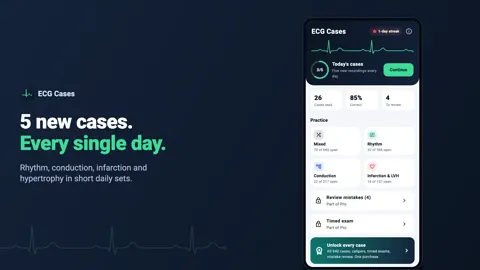
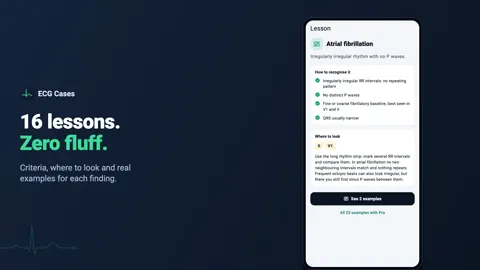
There are 16 short lessons, one page per finding: how to recognise it, where to look, common traps and real example recordings. Five new cases arrive every day. You can do mixed practice or practise by group, keep a daily streak, and check your score for each finding to see what still needs work. A timed exam mode lets you rehearse under pressure.
The app is available in English, Spanish, Portuguese, French, German, Indonesian, Turkish, Arabic and Vietnamese. It works offline, has no account and no ads.
ECG Cases is a study aid, not a medical device.
Where do the ECG recordings come from?
They come from the PTB-XL and PTB-XL+ open datasets on PhysioNet, used under the Creative Commons Attribution 4.0 licence. Every recording is stored inside the app.
Which findings can I practise?
Rhythms such as sinus tachycardia, atrial fibrillation and paced rhythm, conduction patterns such as bundle branch blocks, and infarction and hypertrophy patterns. Sixteen short lessons cover the findings, including atrial flutter, Wolff-Parkinson-White and long QT.
Can I use it to read my own ECG?
No. ECG Cases is a study aid. It does not interpret your own ECG and does not give medical advice, diagnosis or treatment.
Does it need an internet connection?
No. The recordings are inside the app and it works offline. Nothing you do in the app leaves your phone.